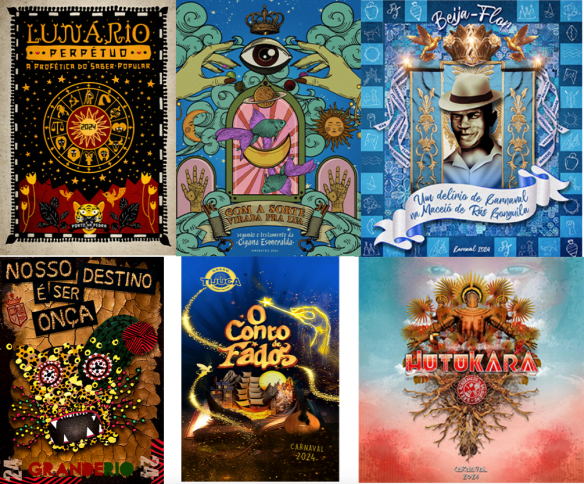
The main parades of the Grupo Especial in Rio de Janeiro’s carnival take place on the nights of Sunday, 11 February and Monday, 12 February 2024. The 12 schools will parade in the following order and their themes are:
SUNDAY, 11 FEBRUARY
Porta da Pedra
The plot of “Lunário Perpétuo: A Profética do Saber Popular” (Perpetual Lunary: The Prophetics of Popular Knowledge) is based “Lunário Perpétuo”, an almanac that dates back to medieval times, written in the 14th century in Spain by Jerónimo Cortés. The book travelled the world, arriving in Brazil and becoming one of the most widely read books in the Northeast for nearly 200 years.
Beija-Flor
“Um delírio de carnaval na Maceió de Rás Gonguila”” (A Carnival Delirium in the Maceió of Rás Gonguila) pays homage to the city of Maceió through the story of Rás Gonguila, a shoeshine boy and porter who lived in Maceió at the beginning of the 20th century. Passionate about Carnival, he founded Cavaleiro de Montes, one of the main blocos in the Alagoas capital at the time. Gonguila also proclaimed himself a member of the Ethiopian monarchy, became the Ethiopian Prince of Alagoas and an influential person who was consulted by politicians and intellectuals.
Salgueiro
In the Yanomami language, “hutukara” means “the original sky from which the earth was formed”. In 2024 Salgueiro is telling the story of the Yanomami people who occupy the largest Indigenous land area in Brazil with a samba that comes out in defence of Brazil’s indigenous peoples and defends the preservation of the Amazon.
Grande Rio
Guided by the mythical narrative of the book by Alberto Mussa, the plot for “Nosso destino é ser onça” (Our Destiny is to be a Jaguar) is a reflection on the symbolism of the jaguar for the Tupinambá people. Grande Rio promises to explore the jaguar’s link within different manifestations of Brazilian culture and express the strength of Brazil’s native peoples.
Unidos da Tijuca
“O conto de fados” (The Fairy Tale) looks at the history of Portugal through the country’s legends and tales, as well as showing the Portuguese cultural influence on Brazil. Tijuca, has strong links with Portugal, and had Vasco da Gama, a club founded by Portuguese immigrants and their descendants, as its theme in 1998, and the Portuguese language in 2002.
Imperatriz Leopoldinense
The reigning carnival champions close the first night with the storyline “Com a sorte virada pra lua segundo o testamento da cigana Esmeralda” (With Luck Turned to the Moon According to the Will of the Gypsy Esmeralda). The story is fictional and tells the tale of a gypsy who tries to decipher the world of dreams, palm reading, the influence of the stars on everyday life, lucky numbers, dates for good and bad things to happen and other forms of fortune-telling.

MONDAY, 12 FEBRUARY
Mocidade
With the storyline “Pede caju que dou… Pé de caju que dá!” (Ask for a Cashew and I’ll Give You One… I’ll Give You a Cashew!) Mocidade looks at the cashew fruit with its stories, legends and curiosities, and even puns. The idea is to show the “Brazilianness” behind this fruit that was one of the first treasures taken by the colonisers when they arrived in Brazil.
Portela
The storyline of “Um defeito de cor (A Defect of Colour)“, is based on the novel of the same name by writer Ana Maria Gonçalves, and tells the story of the character Kehinde, who is also Luísa Mahin, a formerly enslaved woman of African origin who is believed to have taken part in the organisation of the slave uprisings that shook Bahia in the first decades of the 19th century. The samba depicts the trajectory of this black heroine and shows passages from Afro-Brazilian history to tell of Luísa’s connection with her son, the black abolitionist lawyer Luiz Gama.
Vila Isabel
In 2024 Vila Isabel returns to its 1993 storyline “Gbala – Viagem ao Templo da Criação” (Gbala – Journey to the Temple of Creation). The plot is based on a fictional story from Yoruba culture to show the harm mankind does to the world and to argue the case that children and their purity are the salvation of the planet. The samba was written by the great Martinho da Vila.
Mangueira
The famous “verde e rosa” will pay homage to the great samba singer Alcione with “A negra voz do amanhã” (The Black Voice of Tomorrow). It is the story of the singer from Maranhão, starting from Alcione’s childhood and musical beginnings in São Luís to her connection with Mangueira. It will also reflect Alcione’s contribution to its youth school, Mangueira do Amanhã, of which she is the founder and president of honour.
Paraíso do Tuiuti
“Glória ao Almirante Negro!” (Glory to the Black Admiral!) will use the language of comic books to tell the story of João Cândido, the Brazilian naval rating led the Revolta da Chibata in 1910. Cândido led his peers in the navy in a revolt calling for an end to the mistreatment, malnutrition and physical punishment of sailors, which had already been abolished at the beginning of the Republic, but was still in use.
Viradouro
The closing storyline of “Arroboboi, Dangbé” talks about the energy of the cult of the powerful serpent god of Voodoo mythology, Vodou, the force that manifested itself in epic battles on the West Coast of Africa and influenced the struggles of the all female Mino warriors of the kingdom of Dahomey, a dynasty of women chosen by the python spirit, Dangbé.




 Rio the Guide