 Carnival proper starts many, many months before the actual parade when each of the schools will meet individually to decide what the theme – the enredo – of their particular presentation will be.
A diverse selection of themes and story lines will be chosen to be presented each year. A theme to hopefully excite the school’s followers and those that will take part.
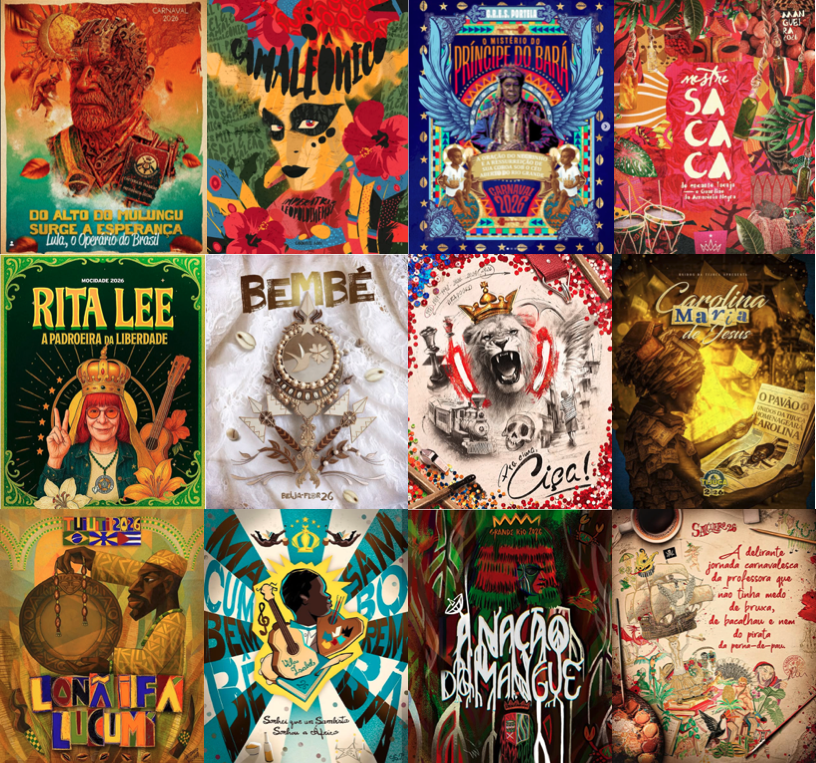
In 2026 they included the samba called “The Delirious Carnival Journey of the Teacher Who Was Not Afraid of Witches, Codfish or Even the Pirate with a Wooden Leg” (“A delirante jornada carnavalesca da professora que não tinha medo de bruxa, do bacalhau e do pirata da perna-de-pau”). Salgueiro’s tribute to carnavalesco Rosa Magalhães, one of carnival’s greatest, who died in 2024. The theme a playful parade inspired by the artist’s creative career, bringing together characters, myths and references from her historic parades from past carnivals. Acadêmicos de Niterói offered a theme based on the life of President Luiz Inácio Lula da Silva. Imperatriz paid tribute to Ney Matogrosso, one of the biggest names in Brazilian music. Portela honoured Prince Custódio, a historical and spiritual figure of African origin from the 19th century, highlighting the black presence in southern Brazil and the amalgamation between African-based religions and popular traditions. Mangueira told the story of Mestre Sacaca (Raimundo dos Santos Souza), a reference in Afro-indigenous knowledge in Amapá. Known as the “Doctor of the Forest,” he was renowned for his knowledge of Amazonian herbs, roots, and saps, used in the treatment of diseases and community care. Mocidade paid tribute to Rita Lee, who died in 2023. The samba celebrates the musical, aesthetic and behavioural legacy of the artist, a symbol of avant-garde and freedom of expression. Beija-Flor focused on the Bembé do Mercado, a ceremony held for over 130 years in Santo Amaro da Purificação, considered the largest street candomblé in the world. Viradouro, the champions, paid tribute to Mestre Ciça who will turn 70 in 2026 and is taking part in his 55th parade. He won two titles for Viradouro, in 2020 and 2024, and is recognised for his longevity, strength and innovation at the head of the school’s percussion section. Unidos da Tijuca paid tribute to writer Carolina Maria de Jesus. Considered one of the most powerful voices in Brazilian literature, Carolina portrayed life in the favelas and social inequalities in depth. Paraíso do Tuiuti theme ,”Lonã Ifá Lukumi”, addressed an Afro-Caribbean religion being rediscovered in Brazil, mixing Brazilian and Caribbean sounds in the melody. Vila Isabel honoured Heitor dos Prazeres, an artist who played a fundamental role in the history of samba and carnival. Creator of the expressions “Little Africa” and “Africa in Miniature,” Heitor participated in the first carnival ranchos, and has had internationally recognised works, including a painting acquired by Queen Elizabeth II. Grande Rio looked at Manguebeat, a cultural movement that emerged in Pernambuco in the 1990s, mixing regional rhythms such as maracatu with rock, hip-hop, and electronic music.
In 2025 the themes included Padre Miguel paying homage to the history of the Terreiro da Casa Branca do Engenho Velho, the first Candomblé terreiro (Afro-Brazilian temple) in Brazil; Imperatriz Leopoldinense told the story of Oxalá’s desire to visit the kingdom of Xangô, both orishas (divine spirits) and kings within axé culture; Viradouro presented the story of Malunguinho, a hero of the 19th century and the leader of the Catucá Quilombo (a community organised by fugitive slaves) in the north of Pernambuco; Mangueira explored the arrival of the Bantu people at Rio’s Valongo Wharf and the black presence in the centre of Rio, from the influence of the Bantus to the current reality; Unidos da Tijuca featured Logun Edé, an orisha and boy saint that old men respected, carrying the essence of youth but the strength of traditions; Beija-Flor, the winning school in 2025, celebrated the work of the school’s carnival director, Laila who died in 2021. It highlighted his work in the history of Brazilian carnival along with his invaluable contribution to Beija-Flor’s own story; Salgueiro dived into the rituals used by different cultures throughout history in the search for spiritual protection, including African beliefs, indigenous practices and elements of Rio’s popular culture; Vila Isabel took a walk from childhood to adulthood through the universe of fantastic beings and hauntings that are very strong in Brazilian popular culture; Mocidade took an intergalactic journey that began with the star of Mocidade, the symbol of the school, and the need for the school to shine and return to its former brilliance. At the same time, the school looked at the importance of stars in our lives following on from the Big Bang; Paraíso do Tuiuti told the tale of the first documented trans woman in Brazil, Xica Manicongo, a striking figure who carried within her the resistance and struggle for identity and freedom; Grande Rio plunged into the mysterious waters of the state of Pará and focused on the enchanted entities that inhabit the pororocas, where the rivers meet the sea; and finally Portela honoured the great singer-songwriter Milton Nascimento, highlighting his career and contribution to Brazilian music. A tribute that marked the first time that Portela had honoured an artist during their lifetime. The history and importance of Minas Gerais and Brazilian popular art were also a large part of Milton’s story.

In 2024 on the first night of parades Salgueiro told the story of the Yanomami people who occupy the largest Indigenous land area in Brazil; Beija-Flor paid homage to the city of Maceió through the story of a shoeshine boy and porter who lived in Maceió at the beginning of the 20th century; Grande Rio explored the jaguar’s link within different manifestations of Brazilian culture; Porto da Pedra was based on “Lunário Perpétuo”, an almanac that dates back to medieval times and became one of the most widely read books in the Northeast for nearly 200 years; Unidos da Tijuca looked at the history of Portugal through the country’s legends and tales, as well as showing the Portuguese cultural influence on Brazil; Imperatriz Leopoldinense, winners in 2023, had a fictional tale of a gypsy who tried to decipher the world of dreams, palm reading and other forms of fortune-telling.
On the second night of parades in 2024, Mocidade looked at the cashew fruit with its stories, legends, curiosities, and even puns; Portela told the story of the Kehinde, a formerly enslaved woman of African origin who is believed to have taken part in the slave uprisings that shook Bahia in the first decades of the 19th century; Vila Isabel was based on a fictional story from Yoruba culture to show the harm mankind does to the world and to argue the case that children and their purity are the salvation of the planet; Mangueira paid homage to the great samba singer Alcione and also reflected on her contribution to its youth school, Mangueira do Amanhã, of which she is the founder and president of honour; Paraíso do Tuiuti used the language of comic books to tell the story of João Cândido, the Brazilian naval rating who led the Revolta da Chibata in 1910; and Viradouro, the winning school, talked about the energy of the cult of the powerful serpent god of Voodoo mythology, Vodou.

Historic figures often feature and in 2023 the winning school, Imperatriz Leopoldinense, travelled to the northeast and told the story of the arrival in both heaven and hell of the bandit leader and folk hero, Lampião. Viradouro told the story of Rosa Maria Egípcia, who was brought from Africa to Brazil in 1925 and is credited as the first black woman to write a book in Brazil, while Paraíso do Tuiuti told of the arrival and impact of buffaloes to Brazil, through the Marajó Island, in Pará, which inspired a cultural manifestation in the region.
Other enredos in 2023 included Vila Isabel that celebrated the human capacity to have faith in what cannot be seen; Salgueiro chose a plot about valuing freedom of expression, showing that paradise is built individually by each person, without restriction or sin. Mocidade looked at the cultural legacy of artists from Alto do Moura in Pernambuco, and the disciples of the artist Mestre Vitalino.
The state of Bahia was featured by three schools in 2023. Unidos da Tijuca celebrated everything about Bahia, taking a lot of axé to the avenue and the joy of Bahia’s carnival. Mangueira highlighted the impact of women on the music of Bahia, while Beija-Flor argued that the “true” independence of Brazil was the expulsion of the Portuguese troops from Bahia 200 years ago in 1823.
In 2020 the winning theme of Viadouro was a celebration of women’s empowerment, based on the Ganhandeiras de Itaupu, a group of female descendants of slaves. Mangueira looked at Christ returning to Rio; Paraiso do Tuiuti imagined a meeting between Dom Sebastião, King of Portugal, and Saint Sebastião; Grande Rio looked at religious tolerance; Poretla looked at Rio before the arrival of Europeans; Salgueiro celebrated the great black clown, Benjamin de Oliveira, and the circus; and Unidos da Tijuca celebrated Rio’s architecture.

In 2019 the winning theme and premise of Estação Primeira de Mangueira’s parade was the forgotten figures of Brazilian history. The people who do not feature in the history of Brazil as it is taught in school. Second placed Viradouro looked at the magic of children’s stories. Grande Rio discussed the good and bad in education; Vila Isabel chose the Imperial city of Petropolis as its theme; Portela told the story of the great sambista, Clara Nunes; Beija-Flor looked back over its history in the year of its 70th anniversary; and Imperatriz Leopoldinense, that was relegated, had money and the economic crisis as its theme.
 In 2018 themes were as diverse as the influences of China and India on Brazil; slavery and immigrants; the National Museum and the School of Fine Arts; the entertainers Chacrinha and Miguel Falabella; Brazil’s culinary delights; man’s inventions and discoveries and their impact on the environment; the importance and influence of black women; and approriately, the importance of carnival to the people and city of Rio, even in an economic crisis; and using the hook of the 200th anniversary of the publication of “Frankenstein”, a look at the persecution and intolerance to people who are different. A theme that was to win the carnival crown for Beija-Flor in 2018.
 In 2017 the winning schools, Portela, chose as its theme rivers, and Mocidade chose “1001 Nights”, while in 2016 Mangueira chose o celebrate the life of the iconic Brazilian singer, Maria Bethânia. In 2014 the samba of the winning school, Unidos da Tijuca, was based on the life and times of Brazilian Formula One great, Ayrton Senna, while Imperatriz Leopoldinense looked at the life of one of Brazil’s greatest footballers, Zico.
 As each school chooses its theme individually it is quite possible, but unusual, that more than one school will choose the same theme. This did happen in 1994 when Imperatriz Leopoldinense, the eventual winner, and Império Serrano, who came last, both chose as their theme the unusual topic of the visit of the Tupinambás and Tabajaras Indians to the French court in the 16th century. In the same year Mocidade Independente had as its theme the Avenida Brasil, the principal access road to Rio, while Caprichosas de Pilares chose Avenida Rio Branco, the main street in downtown Rio. While in 2015 three schools picked themes based on Brazil’s historic relationship with Africa.
 Rio the Guide